Culture survives by being used, remembered and passed on.
LEMKO.org preserves language material, poetry, literature, customs, dress, photographs and community documentation. These collections show that Lemko heritage is not only a subject of history; it continues through speech, writing, music, family memory and public gatherings.
Language
Enter the existing language resources, texts and linguistic material.
Poetry & Literature
Explore poetry, writing and literary works preserved in the collection.
Art & Customs
Traditional art, customs and material culture from across the archive.
Traditional Dress
Photographic records of clothing, ornament and cultural presentation.
Festivals & Gatherings
See culture practiced publicly across generations and communities.
LemkoHUB
Continue to contemporary music, performances and audiovisual cultural material.

Traditional dress is more than a museum object.
Your recent festival photographs show clothing and ornament being worn by real people at contemporary gatherings. Placing those images beside historical material makes the continuity visible.
The same principle applies to language: the archive should preserve old texts while also pointing toward people who continue to speak, sing and create today.
Visit LemkoHUB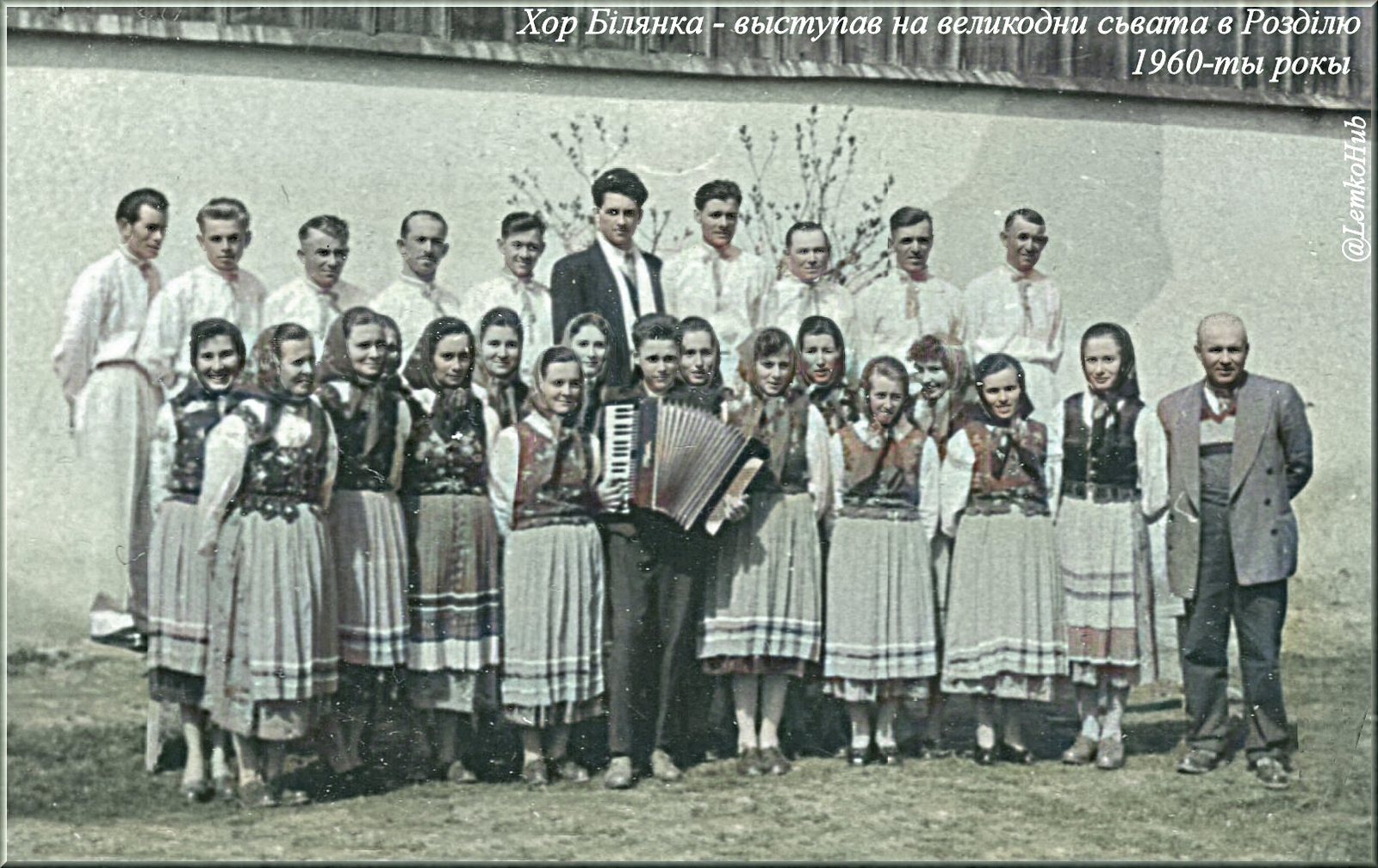
Bielanka choir, Rozdziele, 1960s
This modern colorized version was made from an original black-and-white photograph only about the size of a business card.
The identification was preserved from information on the reverse of the original. The photograph shows the Bielanka choir performing during the Easter holidays in Rozdziele in the 1960s.
Archive note: colorized derivative. The original black-and-white photograph remains the archival source and should be preserved separately, together with an image of its reverse-side identification.
Some distinctions cannot be preserved by spelling alone.
One important example is the traditional Lemko sound represented by Cyrillic Ы / ы. For many speakers it is a characteristic sound of Lemko and neighboring Carpathian Rusyn speech. Younger descendants may replace it with a sound influenced by the languages around them.
Я был
I was. The word был contains ы.
Я бил
I hit / I was hitting. The change of vowel distinguishes the word from был.
A remembered teaching example
Speakers often illustrate the contrast with the humorous idea: “I was there, but I didn't hit anybody.”
The remastered Language section should eventually pair examples like these with recordings of native speakers from different generations, so visitors can hear the distinction rather than relying on approximate comparisons with Polish, Ukrainian or Russian sounds.
People, language & literature
Julia Doszna → · Julia photographic archive → · The Lemko Ы / ы sound → · Poetry collection → · Epifan Drovniak / Nikifor — Krynica archive →
More to explore
- Polish-Language Collection — Explore preserved Polish-language cultural material.