Wstęp/lntroduction - Andrzej Osęka
Wprowadzenie/Foreword - Zbigniew Wolanin
Reprodukcje prac/Reproductions - Janusz Rosikoń
Portrety Nikifora/Nikifor's Photo Portraits - Marian Włosiński
Tłumaczenie/Translation - Teresa Batuk-UIewiczowa
Redakcja/Editor - Anna Szczucka
Korekta/Proof-reading - Joanna Kułakowska
DTP Inter Line s.c. Kraków
Przygotowalnia, druk i oprawa/Printing and binding - Gorenjski Tisk, Kranj - Slovenija
Wydanie pierwsze/First edition
Wydawnictwo BOSZ s.c.
Olszanica 2000
ISBN 83-87730-18-1
Copyright by BOSZ s.c.
Wydawca/Publisher
BOSZ s.c.
38-622 Olszanica 311; Biuro: Lesko, Pierzeja 2
tel. ++ 48 (13) 4699000, 4699010
tel./fax++48 (13) 4696188
e-mail: boszsc@ks.onet.pl
www.bosz.com.pl
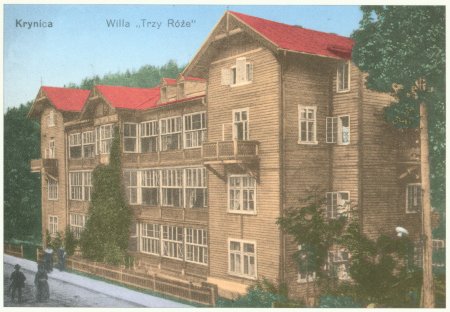
Willa "Trzy Róże", w ktorej pracowała matka Nikifora
Villa "Three Roses" where Nikifor's mother worked.
Villa "Three Roses" where Nikifor's mother worked.
Muzeum Okręgowe w Nowym Sączu posiada największą na świecie kolekcję prac Nikifora, która liczy prawie tysiąc obrazów, gromadzonych systematycznie od 1949 r. Daje ona pełny przegląd twórczości malarza. Po śmierci Nikifora muzeum zostało spadkobiercą jego spuścizny artystycznej i pamiątek osobistych. W 1995 r., po wielu latach starań, doszło do utworzenia Muzeum Nikifora w Krynicy, którego idea zrodziła się jeszcze za życia artysty. Muzeum Okręgowe w Nowym Sączu podjęło się realizacji tego zadania i doprowadziło do jego urzeczywistnienia, za co otrzymało od Ministra Kultury i Sztuki l nagrodę w Konkursie na Najciekawsze Wydarzenie Muzealne Roku 1995 w Polsce. Muzeum Nikifora znalazło siedzibę w zabytkowej willi „Romanówka" w centrum Krynicy i funkcjonuje jako oddział Muzeum Okręgowego w Nowym Sączu.
Muzeum Okręgowe in Nowy Sącz has the largest Nikifor collection in Poland, and probably in the world as well giving a full overview of Nikifor's work in the wide rangę of subjects hę addressed. It amounts to over one thousand works, which have been systematically collected sińce 1949. After Nikifor's death this museum inherited his artworks and also the handful of personal effects he left. In 1995 a museum specially dedicated to Nikifor opened in Krynica. It is a branch of the Muzeum Okręgowe in Nowy Sącz, and it resides in Romanówka, a historie house in the centre of the spa resort. The Nowy Sącz museum has put into effect an idea that was born still during the artists lifetime, and it was awarded the first prize by the Polish Minister for Culture and the Arts for the most important achievement in museum affairs in 1995.
A Sacred Grey and Green World. One of Nikifor's pictures which I bought just after the War from him when he used to sit out near Willa Patria in Krynica hangs on my wall. He would often be out painting there, using school paint sets and licking his thin brush. My picture has a frame and a loop to hang it on, made by Nikifor himself. Both the frame and the loop are in a warm pink and brown, in excellent harmony with the coo greens of the landscape, a view of the house against the background of a woody hill. There is also a delicate touch of gold: an inscription from a chocolate wrapper on the frame. In Nikifor's painting the color combinations are extremely subtle and sophisticated. He never resorts to the parrot colors typical of many naive artists. He never decorates his surfaces with colored blobs; he locates the color inside the picture, in the depths of a receding space. As they recede these colors fade. His pictures are not "stories" - as often happens in naive art - recounting detail by detail whatever the artist wants to show us; they're not an enumeration of objects and figures, but the presentation of a homogeneous entity, a logically constructed world. Moving about within a fairly narrow color range, Nikifor proves a master in the spatial arrangement of colors. We may call him a great master of color.
I was making a film on Nikifor's painting. It was a short film, but still required hours spent on montage. On the small screen I watched a sequence of pictures: the houses of the historic part of Krynica; Roman and Eastern-rite churches spired or onion-domed; real or fabulous views of towns; ornamental street-booths; railway stations, made a visual journey many times over through the same views of Nikifor's gray and green world.
A short time later was travelling on the suburban railway to one of the places on the outskirts of Warsaw. Looking out of the window, wherever I cast my eyes, I could see Nikifor. The environs of Warsaw are different from the landscape around Krynica, yet the houses, little stations, steel trellised frameworks, and sleeper railway tracks I passed - all of them were full of the naive painting I knew from Krynica.
This is not really a unique phenomenon. After spending a long time in intimate contact with someone's art or prose, when we look out at the streets, interiors, figures, when we listen in on conversations, we inevitably observe a gamut of colors we know from the pictures we have been looking at, or we hear the dialogues we have been reading.
But for such a phenomenon to occur the reflection of the world in the given art form must be particularly intense; it has to penetrate profoundly into the heart of the matter we encounter around ourselves. The artist - like Degas, Monet, Max Gierymski, or Boznanska - who treats us to such a surprise is always more than just a creator and visionary; he is also a congenial observer of reality. The mute and illiterate Nikifor was such a visionary and extremely sharp-eyed observer of reality.
Nikifor drew a lot from nature; houses, churches, streets, views of town. He would sit by the Willa Patria or other parts of Krynica and watch: the houses, their balconies, roofs, the railways lines, the spruce-trees along the embankments. Then it all got mixed up, or perhaps melted down according to a specific set of rules. In his water-colors we can make out not only the architecture of Krynica but also St. Mary's of Krakow, the interior of an Eastern-rite church with its characteristic arrangement of icons in the iconostasis, the decorations of the apartments in a palace, a railway station with its complex mesh of tracks, the pinewood-clad Podhalanian hills with their pattern of sparsely distributed buildings. Nikifor would sign his pictures. Mine bears the inscription "KRYNICA WILLA aaalCI DaURN = KRAKOW." Evidently the realities of Krynica and Krakow merged in his imagination. He used to come up to Krakow and admired the city.
Nikifor views the Gothic, Renaissance, and Baroque houses and churches of Krakow as if they were all town houses of Krynica, with their capricious little towers and their high-stacked roofs. Some things he faithfully reproduces; some he adds. But at the same time he sees a bandstand well-nigh as a temple. It's the same with a railway station, a tunnel entrance, a windmill, or chimney factory - in this art they all have a peculiarly ceremonious character. They are no less sacred than the church, but they do not become any less real because of it; they preserve their matter, their easily discernible spatial rhythm. Nikifor's art is based on the music of the rhythms he has discovered in the surrounding world, in its architecture and landscape. Diagonal lines, parallel lines, arched lines, crossing each other at diverse angles, thick and thin lines, alternately sparsely and densely distributed along a plane - so very accurately reproduce the nature of a building, row of windows, arrangement of roofs, drainpipes, curtains, balustrades, trees along a drive, staircases, bends in a railway track or along a road. His telegraph poles, insulators and wires turn into a ceremonial ornament. Nikifor, who was brought up on the art of icons, has taken from icon-painting not their external stylistics, but a way of presenting the world. In these paintings he is both real and symbolic, material and ceremonial. He misses out all that is random and changeable: passers-by, all vehicles whatsoever, animals, traffic. He leaves in the most important things. He is fond of emphasizing symmetry; he likes the badges of office: bishop's mitres, top-hats, cloaks - and dresses up himself in them. He is a bishop, a master of undefined ceremonies, and at the same time a painter with a case for his brushes and paints.
But he achieves the loftiness and hieratic quality of his art not through the proliferation of signs and attributes, but through the shaping of the matter itself, through the conducting of lines. Roof-tiles, drainpipes, boards and posts in the elevation of a wooden house; the trees next to a fence; the gray-green of the trees; the subdued red of a sky at sunset - it's from that kind of component part that his arrangements are built up, so strikingly close to the truth, so precise and so serious. His iron bridges are no less superb than his palatial stairways. In his art kitchens and church interiors essentially belong to the same order, in which the same ceremonial reigns supreme, and is visible in the meticulous distribution of objects, in their hierarchy, in the stiff poses of the figures, in the lines as strong as columns, and the ritually hanging folds of the draperies.
From what we know about the artist's life he must have experienced the world as a universe inaccessible to him, an object of adoration and longing. What he saw around him was splendor. He painted himself in costumes he never had; with books, although he could never read. He donned wigs he had probably seen in old paintings of dukes and judges. But the only way he had to really enter a world that was inaccessible to him was to see it and paint it.
Nikifor watched the world with extraordinary attention, zealously. Often without understanding the sense of the buildings or spatial arrangements, he would endow them with a meaning drawn from his own intuition, his own ideas on dignity. But above all he endeavored to capture the shape of things and transfer it to his rough cardboard surfaces.
He followed a linear path he knew from the icons. But he did not stop at the play of lines. Neither are the colored blobs in his paintings ever as flat as in icons. In his gray and green pictures he could inscribe the climate, atmosphere, humidity of the surrounding world. A world which was his everyday life, and which he had, or wanted, to regard as holy, since he made it holy, endowing people and things with the symbols of holiness and dignity: bishops' mitres, domes, spires, top hats, wigs. He was able, in the material and artistic sense, with a moving but impressive modesty, to observe and put it all together.
Andrzej Osęka
Andrzej Osęka (born 1932). Art critic and journalist. Associated with Polish cultural periodicals like Po prostu, Przegląd Kulturalny, the weekly Kultura, the samizdat monthly Kultura Niezależna (1980's), and the emigre publication Kultura (Paris), where he published as Paweł Morga. Awarded the Mieroszewski Prize, 1986. Now writes for Gazeta Wyborcza. Has also published several books, including Poddanie Arsenalu (Surrender of the Arsenal), Mitologie artysty (Mythologies of the Artist), Sztuka z dnia na dzień (Art From Day to Day), Styl EXPO (EXPO Style, with Anna Piotrowska as co-author), Coś się kończy, coś się zaczyna (Something's Ending, Something's Beginning), and Jawa czy sen (Dream or Waking Reality).
,,Art is a manifestation of certain levels in the life of the soul. What must the hidden life be like of a soul we have termed 'primitive', if it produces masterpieces? ... Over the centuries innumerable canvases and boards have been covered with paint, but these pieces of paper were not like anything I had ever seen up to that time." (Jerzy Wolff, Malarze naiwnego realizmu w Polsce, Nikifor, Arkady: 1938).
Nikifor is one of the most fascinating personalities in 20th -century European art. Born and bred in extreme poverty, towards the end of his life he was accorded the honor of having his paintings displayed all over the world in the most prestigious galleries. He acquired international renown, and was exhibited in the company of works by the most distinguished contemporary Polish artists, such as Jerzy Nowosielski, Tadeusz Brzozowski, and Jan Lebenstein. Today, 30 years after his death, Nikifor is still a figure of controversy and mysteriousness. What can be said of him definitively is that he was a Rusnak (Lemko), and that he was an "artist and painter", as he called himself in his early youth, in advance as it were, thereafter proving the appellation through his life's work. He lived at the cultural cross-roads of East and West, and he took from the heritage of both. Information regarding Nikifor's early life is extremely sketchy. He was born around 1895 in the village of Krynica Wies, the son of a disabled, single, and extremely poor country woman, who earned her living as a charwoman in Krynica's holiday and health pensions. Nikifor's mother - "Odocha", "Onycha", or "Odoska", as people recalled her familiar name and diminutive figure, had no place of her own in life. She wandered round Krynica and its surrounding villages with her son, occasionally lodging in various people's houses where she managed to find employment or pity. Nikifor inherited his mother's disability. His incoherent speech made normal contact with other people and attending school impossible. Apparently he did spend some time at school, but basically he was illiterate. However those who found the time for him and listened to what he had to say managed to communicate quite well with him, but there were only a few of them and they came into his life late. That is one of the reasons why questions regarding Nikifor's life and art have remained unanswered. Anyone who writes about him has to resort to conjectures.
Above all, we cannot answer the two basic questions, relating to his identity and the origins of his art. We don't know at all where the name "Nikifor" came from, which he used from his early days but which was probably not his real name. Already between the Wars Nikifor was known in Krynica as "Nikifor Matejko". Whether he himself appended this surname to his own name to emphasize the artistic value of his works, or whether someone else applied it to him as an offensive nickname will remain a mystery. But he must have liked the linking of the greatest Polish artist's name with his own, since he would often use this combination.
For all of his life Nikifor had strong emotional ties with Krynica, where he lived and worked, and where he always returned from his numerous expeditions. He would return to Krynica as one returns from a long voyage to a cozy home, although he never had the home of his dreams in Krynica. He would spread out his artist's workshop in all sorts of odd places, on benches, walls, or directly on the pavement, in the busy parts of the spa. He could most often be spotted out on the promenade, next to Dom Zdrojowy, or near the old tap-room, on the stone wall along ulica Pułaskiego, or near the new mineral baths. In the media and people's genera awareness the figure of Nikifor was inseparably associated with Krynica, so much so that when a need arose for a passport to enable him to leave the country for the only holiday abroad he ever had, in Bulgaria, the document was issued to "Nikifor Krynicki" (Nikifor of Krynica) - an official endorsement of what had been in practical use for a long time.*
[* Nikifor was given the surname Krynicki in 1962. Perhaps his real surname was Drowniak, but hitherto the matter has not been settled definitively. The aim of this album is to present the beauty of Nikifor's art, and academic scrutiny of the complex questions regarding Nikifor's identity, or of any other unexplained matters in his biography, does not lie within its scope.]
Nikifor was a self-taught artist, but he must certainly have been endowed by Nature with an extraordinary talent. Experts speak of his "phenomenal artistic intuition", which helped him to arrive at ideal color compositions quickly and flawlessly. One of the greatest values of Nikifor's art was his palette, recognized by all the scholarly authorities. Most of Nikifor's pictures are watercolors. It was in this technique that those of his works regarded as his best achievements during the inter-war period were made. In later years he also used gouache and crayon. His pencil sketches come from his final years; he didn't manage to fill them in color.
For many long years Nikifor couldn't afford good materials for painting, so he would use any piece of paper he could get, like wrapping paper, old posters, pages out of school exercise books blank on one side, legal forms, cardboard, cigarette boxes, colored cut-out books, photographic paper, tracing paper, etc. It would be no exaggeration to say that many of Nikifor's splendid pictures were made on waste paper. Sometimes he would dilute his paints with saliva, thereby giving rise to amusing situations. Some of the "naive" painters believed that this was where the secret lay of his magnificent colors, and tried to imitate him. Nikifor's workshop consisted of a few boxes of school water-color paints and crayons, a couple of pencils and brushes, and a wooden case to hold his utensils. He would take this case wherever he went to make a picture, and put it into many of his self-portraits. He also had several smaller wooden boxes for his paints. And that was it. We are amazed when we realize that tens of thousands of pictures -many of them have not survived - were produced by this mobile workshop. Another item in his workshop were his seals. Nearly a score of them, in different sizes and designs, all made strictly according to Nikifor's instructions. He applied them to his completed works, endowing them with an official, documented status.
Although Nikifor had an absolute faith in his paintings, and a very high opinion of the value of his art, over the years he never stopped perfecting his workshop. From the rather awkward drawings of his juvenilia, he progressed to sketches of architecture executed with a well-nigh draftsman-like precision in his mature years. He could observe the rules of perspective; he could define proportions, naturally in accordance with what he thought was right. His skills were acquired not merely through many years of manual practice. There are grounds to claim that he made a conscious effort to improve his workshop. A few of his extant drawings in pencil - for instance, a sketch book full of little Eastern-rite churches, and a collection of roadside shrines on a single page, or a sketch showing the various stages in the work of a bee-keeper - are evident study sketches. Sometimes quick working sketches may be encountered on the reverses of some of his well-known pictures. He was a special type of documentary artist recording reality. Whenever he chose a subject for a painting, he would transform reality, amending it in accordance with what he thought was right and he only decided on a subject if he thought it was "worth painting".
Among what must have been several tens of thousands of paintings this incredibly industrious artist made in over half a century, we may distinguish around a dozen and a score of thematic cycles. They are not series, although the sketches made for them might have been done serially. Nevertheless each of Nikifor's pictures is a separate, complete work. Pictures in the same cycle might be separated by intervals of even several decades, that is why ascribing dates to them is so difficult and may be done only approximately. However Nikifor never painted two identical pictures, even when specially requested for it.
Nikifor's road to painting led through the Eastern-rite Church. He was a Uniate - (Ukrainian) Catholic, and ever since childhood must have been to church very many times with his mother. There he must have first come across real paintings. "Icons are a book for the illiterate," these words by St. John of Damascus offer a good expression of what the contemplation of icons meant to this sensitive young man. When we look at his pictures, the scenes in church interiors, church banners with images of the saints, or his self-portraits, we sense the hieratic dignity in those compositions, derived from the religious works of art which were closest to him, and which he studied in church. For his art, just like the art of the ancient icon-painters, was linked in a natural manner with religion; it was his confession of faith.
Like all artists, Nikifor enjoyed travelling. He trekked on foot over the entire Rusnak region (Lemkovyna - wm). These travels were not artistic voyages in the literal sense, but it was during them that his sketches of the local Eastern-rite churches were made.
However he liked to travel by train best, this was the transport he used for his longer journeys. There was definitely something that fascinated Nikifor about train trips, as the splendid pictures he made in their wake show. The familiar mountain scenery changing, new towns, railway stations, Uniate and Latin churches, the people he met - all of that opened up new vistas for his creativity. Aleksander Jackowski, a distinguished expert on naive art, who was captivated by his "landscapes from a train window", has said that he doesn't know of any other works of art which carry such a palpable sense of "landscape in locomotion".
Nikifor's artistic voyages were somewhat untypical , as usually he would travel without a ticket. Sometimes they would be interrupted by a conductor, who would make him get off at the nearest station. Nikifor did not mind very much. He would take his time to closely examine the railway station and make a sketch of it before boarding the next train and continuing his interrupted journey. As we admire the magnificent pictures of his travels, we may endeavor approximately to reconstruct his routes. We discover a series of stations on the Krynica - Stroze - Tarnow -Przemysl line, all the way up to Lviv.
Another theme in Nikifor's work is his railway stations. The municipal ones tend to be huge termini or junctions with lots of criss-crossing lines and platforms and large station buildings. Often they are named: Kraków, Vienna, Bardejow. Then there are the country town stations: Piwniczna, Muszyna, Stary Sącz, Stróze, Bobowa, Sanok; and the tiny rural stops like Milik and many others, names which cannot be identified with any place on the map. But anyone who tried to follow Nikifor's railway routes now would certainly end up lost. His trains often take us to places in the Rusnak hills, such as Florynka or Berest, which never had a railway station. Nikifor simply turned into a railway engineer who marked out and constructed new lines, thereby elevating the status of small places lost somewhere in the mountains.
These works, which we could label as "Beskidy landscapes with small railway stations", could perhaps be acknowledged as his peak achievement. No-one else had depicted the Beskidy Mountains in painting so beautifully and so passionately. Dr. Jerzy Zanozinski, expert on contemporary Polish painting, and the creator of the largest Polish exhibition of Nikifor's work in the Zachęta Gallery in Warsaw, wrote in the catalogue, "Today no-one can no longer have any doubt that Nikifor is the great and innovative discoverer of the beauty of the countryside around Krynica, of the Carpathian countryside in general , with its gentle, forest-covered hills and its chess-board of fields, its wooden and brick-built Latin and Uniate churches, its houses and its holiday homes, in which folkloric components harmoniously co-exist with elements of the Viennese and Cracovian Sezession." Even after his enforced journey to western Poland, where he and other Rusnaks (Lemkos –wm) were resettled in 1947, Nikifor never stopped painting. After his return to Krynica not much later, he could not say where he had been, but had with him watercolors of sea ports and ships.
Some of his earliest very good work, probably from the First World War, show scenes of military offices: soldiers in the Austro-Hungarian army submitting dispatches and reports, high-ranking officers issuing commands, and changes of the guard. A particularly valuable painting in this group is the portrait of the Imperial Family. A handful of surviving pictures from this period includes endeavors to paint generic scenes with ladies and officers, portraits of military dignitaries and an assortment of drawing-room dandies, as well as historic figures, and monuments. His unique multi-picture compositions were made around 1920. They are works consisting of many small pictures, of sizes around 8 x 10 cm, painted on both sides and affixed around a large central picture in a special order, so that they may be turned over and viewed from either side. According to the information available to me, there are two such compositions. One, conventionally known as "The Healing of the Sick Woman", is in the Muzeum Okręgowe collections at Nowy Sącz. The second is in the Muzeum Etnograficzne in Kraków collection.
One of Nikifor's most famous works is the "Triple Self-Portrait", probably his largest surviving picture, 70.5 x 59.5 cm in size. The title doesn't come from Nikifor, but that is the name it is known by in the literature. It's an open question whether it shows a triple representation of Nikifor, or whether the central, most important figure, definitely Nikifor, is flanked by two other artists. While we are on the subject of Nikifor's earliest and most valuable pictures, we must mention the famous "Council" or congress of artists. This is also a large painting, showing the artists in liturgical vestments seated around a set table. Nikifor is seated in the central, most important position, of course. The event takes place in a church interior. The saints look on benevolently from above, from the niches in the walls, while a congested crowd of disproportionately tiny ordinary people curiously peep out from the entrances into the side-naves. A few other similar, much smaller compositions (around 30 x 20 cm), known as the "Artists' Banquets", have survived in the museum collection at Nowy Sącz.
These three works, "The Healing of the Sick Woman", "The Triple Self-Portrait", and "The Council", are effectively unique, presumably the only extant examples of his large-size watercolors. There must certainly have been more of them, but they have perished, like the overwhelming majority of his earliest works. Nikifor's "Prayer Book" is absolutely in a class of its own. In his youth he couldn't afford a prayer book. To keep up with the Jones's in church, he simply made one for himself. Nikifor's "Bible" contains 86 pages filled with minutely detailed drawings of scenes set in various places: heaven, on earth, in paradise, in churches. Whole crowds of people and saints' figures take part in them. The most common motif is a diversely represented vision of the Last Judgement.
His "fantasy architecture" is an absolutely astounding collection. In it Nikifor emerges as a constructor, a surrealist erecting monumental "unpeopled" constructions, in a manner that defies the laws of physics. Tadeusz Szczepanek, Director of the Nowy Sącz museum, called Nikifor "the poet of architecture". Nikifor's administrative offices have to be located somewhere pretty close to the fantasy architecture in his work. He ascribed the status of local powiat offices to the grandest among them; he was probably not aware of any higher-ranking ones. Built with panache, hedged with a variety of architectural details, fitted out with a multiplicity of appliances and safeguarding measures, Nikifor's powiat offices are a cross between a presidential palace and a military stronghold. Sometimes they have an armed guard on duty. Usually the red and white national flag may be seen at their summit. We could also put all of his banks and savings bureaus, dollar-making factories, and post offices in this group. Another important category is his kitchen interiors. His rural kitchens, with their timbered ceilings, are distinctly different from the spacious, bright and much better equipped kitchens in the holiday pensions of Krynica. But whenever Nikifor appears in either type, he is a ways given a hearty welcome. Sometimes he has a permanent place of work in them. These pictures may shed some light on his homeless childhood.
The self-portrait is a theme that is present throughout all the periods of Nikifor's art. If there are any subjects "worthy" of painting, this is the worthiest. Perhaps no other painter in the entire history of art has enhanced the position of the artist in society to as high a status as Nikifor has done. The artist (or painter) is an exceptional person; he performs a very important role in society; and hence he deserves a special place. In the social hierarchy established by Nikifor he is next to the cergymen, or in fact the prelates, of at least episcopate rank! In his self-portraits Nikifor is always young, elegant, arousing admiration, acknowledgement, and respect, n his art he compensated, or indeed more than made up for all that he missed in life. In the 1950's and 60's Nikifor also made portraits of his acquaintances and tourists. These are interesting pictures, especially if of identifiable persons and if the circumstances in which they were made are known. However he never put as much work and talent into another person's portrait as he did for his self-portrayals.
A fairly important position in Nikifor's art is held by places of religious worship: churches, Eastern and Western, synagogues. He painted the places of worship used by a variety of religions, but on religious grounds he cared most about the Eastern-rite churches, and devoted most attention to them. An object of his particularly interest was the Eastern-rite church at Krynica Wies, where he lived for many years and (presumably) was baptized. There are also beautiful views of the
Uniate churches at Mochnaczka, Tylicz, Andrzejówka, Powroźnik, Milik, Labowa, Berest, and many others. Other components of his religious theme were the church banners and figures of the saints.
In the 1940's and 50's Nikifor often used to paint the houses and holiday pensions of Krynica, making a singular contribution to the records of the spa's architectural assets. Some of these premises, e.g. Willa Trzy Róze, Litwinka, or Stara Pijalnia (the Old Tap-Room) are now no longer extant, except on his pictures. A word has to be said about the mysterious inscriptions on Nikifor's paintings. Isolated off socially by the barrier of his speech defect, he had a great need to communicate with other people and endeavored to communicate successfully. His work is such an endeavor. Since he could not write, he drew letters, as if fearing that people would fail to read his meanings correctly without an additional commentary from him. Usually he would draw in his letters along the bottom edge of the picture, all in one sequence without a logical arrangement into a decipherable text. Almost always, however, at least part of the inscription actually corresponds to the contents of the picture and provides relevant information. He regarded pictures, which had no inscriptions as incomplete. He also marked some of the items with symbols telling the observer what their purpose was. On the roof of a ballroom we find a dancing couple; a man's jacket cresting a tailor's shop; and little animals on a veterinary surgery. He would put lighted candles on synagogues. He framed his finished pictures himself with colored-paper edging. The moment marking completion would be when he applied one, or even several, of his stamps to the picture's reverse, providing information, like a water-mark, that the picture, a PAMIATKA Z KRYNICY (souvenir of Krynica), had been made by NIKIFOR - MALARZ or NIKIFOR ARTYSTA.
Nikifor lived in Krynica on the margins of society. For decades he would pore over his street workshop, but no-one in the spa paid very much attention to his art. People just got used to him. "Nikifor Matejko" became one of the Krynican curiosities, almost a sight worth seeing. One or two people even bought a picture, but for many years nobody treated either him or his art seriously. He was perceived more as a vagrant than as an artist. The first to notice him and the values in his painting were the artists who visited Krynica in the 1930's. One was the painter Roman Turyn from Lviv. Thanks to him Nikifor's pictures were being exhibited in Paris already before the Second World War, and were given recognition in the art world, especially by the Polish Paris-based group called the kapisci. Turyn's friends in Paris, particularly Jan and Hanna Cybis, Waliszewski, Nacht-Samborski, Czyzewski and others, were greatly impressed by Nikifor's paintings. In 1938 the painter Jerzy Wolff wrote a large article about Nikifor for the trendy magazine Arkady. However, in view of the imminent outbreak of war, the work of this "weird" painter could not count on greater interest. It was not until the late 50's that Nikifor's art was fully acknowledged. Thanks to Ella and Andrzej Banach his pictures were exhibited in numerous cities in Europe, including Paris, Brussels, Amsterdam, Vienna, Frankfurt, Stockholm, Rome, and Zagreb, as well as in the United States and Israel.
Nikifor's string of successes started in April 1 959 with his being exhibited in Dina Vierna's gallery in Paris, and it is still continuing today. The peak of his career during his lifetime came in 1967, in the great exhibition of his work at the Zachęta in Warsaw. The most important moment after his death was the opening of the Nikifor Museum in Krynica, on 3 1st January 1995.
Nikifor's art defies all attempts at classification. Conventionally we refer to this type of home-bred art as "naive", but precisely in Nikifor's case this term is singularly inadequate. His art is sophisticated and perfect over details. We have to "study" him - look at his pictures many times over to try to understand the content and symbolism they carry, finally to reach a conviction that we shall never really fully comprehend these superficially banal paintings. Perhaps Nikifor's naivete lies in the fact that he believed he could improve the world by painting. "Civilized" modern man will of course smile in amusement at any such idea. Except that Nikifor actually accomplished it! "Nikifor won a marvelous victory over the world: he turned it from foe into friend; he charmed his social environment; he thoroughly transformed it, in compliance with his wishes," Andrzej Banach wrote of him.
The fame Nikifor experienced in his last years went far beyond anything that might have been imagined. Apart from the exhibitions - a few score of them worldwide still in his lifetime - there were four books published on him and hundreds of articles in well over a dozen languages. Eminent poets composed poetry in his honor; and several documentary films, and a TV interview with him, were made. He became an honorary member of Związek Polskich Artystów Plastyków, the Polish artists' union. Pictures by him, which had been sniffed at not so long before, were now being collected by private connoisseurs and national museums. Everyone who visited Krynica wanted a "souvenir". His material situation improved, too, though his personal needs were so modest that he only used up small quantities of the money he made from the sale of his pictures. When in 1967 he came up to Warsaw in his own car, with his friend and legal guardian Marian Włosiński behind the wheel, for the opening of his exhibition in the Zachęta, passers-by stopped and came up to him in the streets, curious about the famous painter Nikifor Krynicki and wanting to see him for themselves. Letters would come from all over Poland addressed to "Pan Nikifor, Krynica".
But all the fuss associated with popularity seemed not to affect Nikifor himself. He was pleased that people were interested in his art, but nothing changed either in his lifestyle or in his attitude to painting. Just as over the past decades, he wandered about every day with his wooden case "to work", onto Krynica's promenade, since nothing in this man's life counted as much as painting. It was a necessary and sacred business, and it determined the sense of his entire existence. As a child he had become convinced that this was what he had been born for, and spent his entire life carrying out the artist's mission.
The mission of Nikifor the Artist and Painter was accomplished on 10th October 1968, when he died in a convalescence home at Folusz. Henceforth the wall in the ulica Pułaskiego would be empty. The old wooden case which for many decades had served as a sort of personal attribute is now on display in his Krynica museum. Inside there is a letter of request from him, with a poignant and prophetic address: "My pictures will remain forever as mementos of me. They're different from other pictures, because they are my own. Please take a closer look at them."
Zbigniew Wolanin
Zbigniew Wolanin (born 1956]. Ethnographer, curator of Muzeum Okręgowe in Nowy Sqcz. Creator of the permanent exhibition in the Nikifor Museum, Krynica, and numerous Nikifor exhibitions in Poland and abroad.
Andrzej Osęka
In Nikifor's painting the color combinations are extremely subtle and sophisticated. He never resorts to the parrot colors typical of many naive artists. He never decorates his surfaces with colored blobs; he locates the color inside the picture, in the depths of a receding space. As they recede these colors fade. His pictures are not "stories" - as often happens in naive art - recounting detail by detail whatever the artist wants to show us; they're not an enumeration of objects and figures, but the presentation of a homogeneous entity, a logically constructed world. Moving about within a fairly narrow color range, Nikifor proves a master in the spatial arrangement of colors. We may call him a great master of color.
Zbigniew Wolanin
As we admire the magnificent pictures of his travels, we may endeavour approximately to reconstruct his routes. We discover a series of stations on the Krynica - Stróze - Tarnów - Przemyśl line, all the way up to Lwów. Another theme in Nikifor's work are his railway stations. The municipal ones tend to be huge termini or junctions with lots of criss-crossing lines and platforms and large station buildings. Often they are named: Krakow, Vienna, Bardejów. Then there are the country town stations: Piwniczna, Muszyna, Stary Sącz, Stróze, Bobowa, Sanok; and the tiny rural stops like Milik and many others, names which cannot be identified with any place on the map. But anyone who tried to follow Nikifor's railway routes now would certainly end up lost. His trains often take us to places in the Rusnak hills, such as Florynka or Berest, which never had a railway station. Nikifor simply turned into a railway engineer who marked out and constructed new lines, thereby elevating the status of small places lost somewhere in the mountains.
Bibliografia/Bibliography
1. Wolff J., Malarze naiwnego realizmu w Polsce. Nikifor, Arkady 1938
2. Bonach A., Nikifor Mistrz z Krynicy, Kraków 1957
3. Bonach A., Pamiątka z Krynicy, Kraków 1959
4. Bonach Elb i Andrzej, Historia o Nikiforze, Kraków 1966
5. Bonach A., Nikifor, Arkady 1983
6. Jackowski A., Malarstwo: Nikifor, T. Ociepka, P. Stolorz, P. Wróbel. Rzeźba L. Kudła. Katalog wystawy w Zachęcie, Warszawa 1958
7. Jackowski A., Notatki o Nikiforze, Polska Sztuka Ludowa 1985, Nr 3-4
8. Jackowski A., Sztuka zwana naiwną, Warszawa 1995
9. Zanoziński J., Nikifor. Katalog wystawy w Zachęcie, Warszawa 1967
10. MadeyskiJ., Nikifor Krynicki 12 reprodukcji, Kraków 1970
11. Szczepanek T., Z badań nad twórczością Nikifora, Polska Sztuka Ludowa l 974, Nr 4
12. Wisłocki S., Przyczynek do biografii Nikifora Drowniaka nazwanego Krynickim, Polska Sztuka Ludowa 1985, Nr 3-4
13. Szczyrbuła M., Jeszcze o Nikiforze. Fakty, domysły i legendy, Polska Sztuka Ludowa 1990, Nr l
14. Szczepański J.J., Biskup jedzie przez morze, „Twórczość" 1972, Nr 6
15. Roszko J., Palenie judaszów. Rozdz.: Nikifor maluje dom, Warszawa 1966
16. Wallis M., Autoportrety artystów polskich, Warszawa 1966
17. Marek T., Nikifor - malarz Mistrz z Krynicy, „Wiedza i Życie" 1961, Nr 4
18. Witz ., Wielcy malarze amatorzy. Matejko z Krynicy, Warszawa 1964
19. Ikony - Nikifor - Nowosielski, Katalog wystawy, Kraków 1959
20. Słownik sztuki XX wieku, Arkady 1998
Local Links:
 Return to Lemko Home Page
Document InformationDocument URL:http://lemko.org/lemko/nikifor/nik3.html
Page prepared by Walter Maksimovich
E-mail: walter@lemko.org
Copyright © LV Productions, Ltd.
E-mail: webmaster@lemko.org
| LV Productions c/o Walter Maksimovich 3923 Washington Street, Kensington MD 20895-3934 USA |
Date last modified: November 3rd, 2002