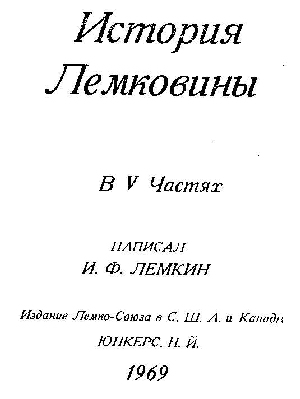
Excerpted from “History of Lemkovyna”, in 5 parts, by Ioann F. Lemkyn, published in distorted Lemko in 1969 by
Lemko-Soyuz of USA & Canada, Yonkers, NY.
vol.1, Part 12 Nationality
Ethnically the Lemkos belong to the large Slavic-Russian family. The name Rus’ [Roosh] was to them a sacred word, and the Slavic ideals always lay deeply within their hearts. Also they always remained on friendly terms with other Slavic nations, but Germans was always seen as enemies. They call themselves Rusyns, Russians, Rusnaks, and Lemkos.The name “Lemko” originates from the word “lem” which is used in their language, and is equivalent in English to mean “only”. Even though lately attempts were made to call them “Ukrainians” in defining their nationality, and at the same time to change their political outlook .......................................so far Lemkos have not accepted this label, nor have they changed their political views.
Residents of the Carpathians are divided into three groups, known as: Lemkos, Boykos and Hutsuls, and this is due to significant linguistic differences. But these three groups taken together however are historically known as Carpatho-Rusyns or Carpathian Rusnaks., and the territory in which they reside as Carpathian Rus’. So the Lemkos are part of the Carpathian Rus’. In each one of these groups, over centuries, a separate language has developed, or a separate dialect. The reasons for these linguistic differences are due to geography and history of these groups. As was already mentioned the Carpathian Mountains are situated vertically on the map, so that the Carpathian roads run mostly North-South. For the Lemkos to reach Boykivshchyna or Hutsulshchyna, they would have to cross the mountains that reached to the sky, then descend from these mountains into the valleys, head east, and again start mountain climbing all over again. For these reasons, there was no permanent contact of Lemkos with Boykos or Hutsuls, and this prevented them from merging into a single entity. However contacts with Carpatho-Rusyns from north and south, due to positioning of these roads, was more favorable. This explains why there are no significant differences between Lemkos on both sides of the Carpathian Mountains, even though each side belongs to a different country, northern to Poland, and the southern part to Czechoslovakia. However differences did develop on the same side of the Carpathians between Lemkos, Boykos and Hutsuls, even though they all find themselves living in the same country [Poland]. Another reason is the fact that both Boykivshchyna and Hutsulshchyna find themselves living in the middle of the Russian population, but Lemkivshchyna lies between Poland and Slovakia. Boykos and Hutsuls were influenced by Galician and Zakarpatska Rus’, and Lemkos by Poles and Slovaks.
vol 1, Part 13
Lemko language by its content and expression is a separate Russian dialect. Since Lemkos were neighbors to Poles, Slovaks and Hungarians, certain expressions from these languages have crept into the language spoken by the Lemkos, but its main development is based on the Old Slavonic, and became developed to such a degree, while self-sustaining itself, that this dialect is not only used by the peasants, but also by the Lemko intellectuals. In this dialect, in the middle of the last century are written and became published many books and periodicals. From the literary Russian and Ukrainian language it differs mainly by the stress, which similarly to the Polish language, occurs always on the second syllable from the end. An unusual property of this language is the fact that it can be understood by every Slav, and vise-versa.
In modern times many dictionaries have been published, even within the Slavic family of languages. For example Russian-Polish, Ukrainian-Polish, Czech-Polish, and so on. But no dictionary is needed for the Lemko language. It is understood by Big Russians and Little Russians, Poles and Czechs, and every other Slav. None of the Slavic languages survived and maintained the character of the original language, as has the Lemko language. If ever in the future, there was to arise a Big Slav nation, about which dream certain Slavophiles, then only on the foundation of the Lemko language, would this new Slavic language develop most faithfully. No wonder that over 50 years ago, in the monthly periodical “Slavic Age” which is published in Vienna, articles in the Lemko dialect were being published. The Lemko language has accumulated certain success. The Lemko literature, even though it finds itself in a very unfriendly position, grows daily. One should also mention that the Lemko language in Lemkivshchyna is not monolithic, there are regional sub-dialects, many expressions have different meanings, and this proves that this language is still developing. Take this for example, the word “potato” in Lemkivshchyna can be described with several different words. [bandurka, gruli, kartofli, barabola.....- wm]
vol 1, Part 14 Religion
Lemkos are of the Catholic and Orthodox faith, but of the Byzantine rite. They themselves call their religion Orthodox or Russian, regardless whether one is Catholic or Orthodox. The Christian faith was taken from missionaries St. Cyril and Methodius in the second half of the 9th century, from Moravia, i.e., 100 years prior to conversion of the Kiev Rus’ to Christianity under prince Vladimir the Great. During the subsequent millennium a religious unity prevailed on Lemkovyna, and the Lemko mountains were out of reach to other cults or religions, and the pure teaching of the Christ have survived to this day, with its beautiful eastern ceremony, always vigorously guarded by the Lemkos. Lemkos never dug deep into the proclaimed dogmas of the faith, but believed in the true words of God, which were proclaimed by their priests, and which passed from generation to generation. Lemko nation, with respect to religion, religious observances and moral standards, always rated well................Lemko nation was characterized with high degree of humility, and being close to their church and its faith. During holiday masses, everybody hurried to a church, and only disabled elderly and small children remained at home. Of significant importance to preservation of their faith, nationality, and the ceremonies, was the fact that the Lemko priests were married, and many of them had large families. Lemko intellectuals were being replenished from families of priests. People had closer ties to the priest and his family. A parish formed a single family in faith, whose father, teacher, and advisor, was the priest, and a mother of the parish was his wife, from whom many women learned domestic skills. Sons of priests were organizers of choirs, clubs, reading circles, where they could deliver their readings, organize stage performances, concerts, and contribute to Lemko education and culture. Married priests contributed a lot to their people. One elderly Roman-Catholic priest in a conversation with a Lemko priest stated: “Your people have moral strength, because your priests are married and have their own families. Soon however, a celibacy will be introduced; soon we will take care of you, and we will weaken your moral strength.” Fateful were the words of this priest, because as soon as the unmarried priests started arriving on Lemkivshchyna, people started loosing faith in them, started to further and further withdraw from them, not finding that family warmth, which was earlier found in the houses of married priests. Unmarried priests they started calling “parobok” [bachelors], because frequently these priests stood lower morally than an average Lemko bachelor. The family warmth was lacking, warmth which kept earlier all parishes warm. In their stead, evil started to creep in, which celibate priests could not successfully challenge, and as a result their faith started to shrink.
vol 1 Part 16 Beliefs and Customs
[Note: These are pre-WW II practices - wm]
When a Lemko is starting to build a house, he must first inspect the site, where he intends to build his house, to determine suitability of the place, whether it will good and not harmful. For this process he performs the following tasks: at the point where the corners of the house will be located, he places a piece of bread for the night. If on the following day the bread is still there, then the site is fit for construction. Otherwise, if the bread is gone, then the site is unfit for construction, and another site would be selected. Afterwards the site is plowed around, to keep the evil spirits away. Performing this work, no shouting or cursing is permitted, since this would result in arguing in the new house, wife's lack of respect for her husband, and children's lack of respect for their parents. After plowing, he places heavy stones at the corners of the future house, as start of the foundation, and above them he places fir [tramy?]. After placement of [spodkov?], he invites a priest to bless the selected site and its foundations. At each corner the priest makes a cross, and inside of it a deep hole, within which he places one-fourth of a silver coin (for self sufficiency), leaves of "barvinok" [periwinkle] for girl's early marriage, flowers from "osika" [aspen tree] or "vuzhderevo" [?] , (so that no sin will find hospitality within this house), leaves from "topola" [poplar tree] (so that children will behave themselves, and will grow well), a "prosforka" wrapped up in cloth (so that God would look over the builder's reliance for bread and earnings), a piece of glass (so that the evil spirits would never approach his house, and so that the help around the house would always stay healthy).
Lemko wouldn't ever dare to chop down an old fruit tree, because this act would bring on him and his family a great misfortune: he could die within a year, the kids might remain sick, the cattle would start to die, hail would destroy his fields of grain, etc. For this kind of work he would usually hire a gypsy or a bum.
When a homeowner heads out to sow oats for the first time, and when everything associated with planting is ready, the housewife puts on a sheepskin coat, turned inside out, walks three times (following the sun) around the horse drawn cart, loaded with the planting oats, in her hands she's holding the holy water and sprinkler, with bread on her bosom, and sprinkles the cart, grain, horses (oxen), the homeowner, while reciting words from the 50th Psalm. The bread she places in front of the oxen, over which the homeowner makes a sign of the holly cross, three times, and then rides over the bread with these horses (oxen). This bread is then taken into the field, in addition to a bag with another bread, cheese and eggs in it. After plowing the first furrow, he places the egg in it, and with the soil from the furrow, rubs it on the horses (oxen), for them to stay healthy and strong. If a crow sits down on a freshly plowed field, that is a sign for a plentiful harvest, but if it is "plishka" [wagtail], expect storms and lightning. Good luck is to see, while plowing, a man, bad luck if it's a woman.
Just before planting the seeds, he sews up into the sock, or the pouch from which he intends to saw the grain, a piece of prosforka and some grain, for a good harvest. During a new moon, sowing of "yarets" [barley?], "orkish" [spelt], peas and beans is out of the question, because meals prepared afterwards from them would be harmful to ones health. The same goes for planting of clover, since it will be harmful to cows and calves. To prevent brownouts in a newly planted field, one places in it a piece of shining metal or sheetmetal, from which bad rays of heat will bounce off.
During harvest time, no drinking of alcohol is allowed, to prevent formation of scabs on head and face. During loading of "snopy" [sheaves] on the cart, no talking is done, until the cart is full, otherwise expect misfortune. After delivery of sheaves into the "stodola" [barn], the farmer or his son "babka" [honing stone?] into his teeth, and walks around the cart with it, while sawing fine grain sand over the spot, where the grain will be stored, to keep the mice away. To buy oneself out of the mice, some "merva" [?] is left in the field.
Local Links:
 Return to Lemko Home Page
Document Information Document URL: http://lemko.org/lih/lemkyn.html
Page prepared by Walter Maksimovich
E-mail: walter@lemko.org
Copyright © 1999 LV Productions
E-mail: webmaster@lemko.org
© LV Productions
Originally Composed: April 8th, 1996
Date last modified: May 30th, 1999.